


Key Highlights
- Sole proprietors can significantly reduce self-employment taxes and protect personal assets by converting to an S corp once annual profits reach around $40,000–$60,000.
- The conversion process involves forming an LLC, obtaining an EIN, and filing IRS Form 2553, all of which must be completed within strict deadlines to take effect in the current tax year.
- S corp owners are required to pay themselves a reasonable salary through payroll, making proper payroll and HR tools essential from day one.
- While an S corp offers real advantages in tax savings and liability protection, it comes with added administrative responsibilities that need to be weighed carefully before making the switch.
Starting a business as a sole proprietor is one of the easiest and most common paths for entrepreneurs. There are no formal registration requirements, no complex tax filings, and no separation between you and your business. It's lean, simple, and it works, until it doesn't.
As your revenue grows and your operation expands, the very simplicity that made a sole proprietorship appealing can start working against you. You're personally on the hook for every liability, you're paying self-employment taxes on every dollar of profit, and your business structure may be quietly costing you more than you realize.

That's where the S corporation comes in. For many growing small business owners, converting from a sole proprietorship to an S corp is one of the most impactful financial decisions they'll make. It offers personal liability protection, meaningful tax savings, and a more credible business structure to support future growth.
This guide walks you through everything you need to know, from understanding the difference between entity types, to knowing when the timing is right, to executing the conversion step by step.
Understanding Business Entity Types
Before diving into the conversion process, it helps to understand where a sole proprietorship and an S corporation sit within the broader landscape of business structures. There are five main entity types: sole proprietorship, partnership, LLC, S corporation, and C corporation.
Each comes with its own set of rules around taxation, liability, ownership, and administration. Your choice of entity directly impacts how much you pay in taxes, how exposed your personal assets are, and how you can grow the business over time.
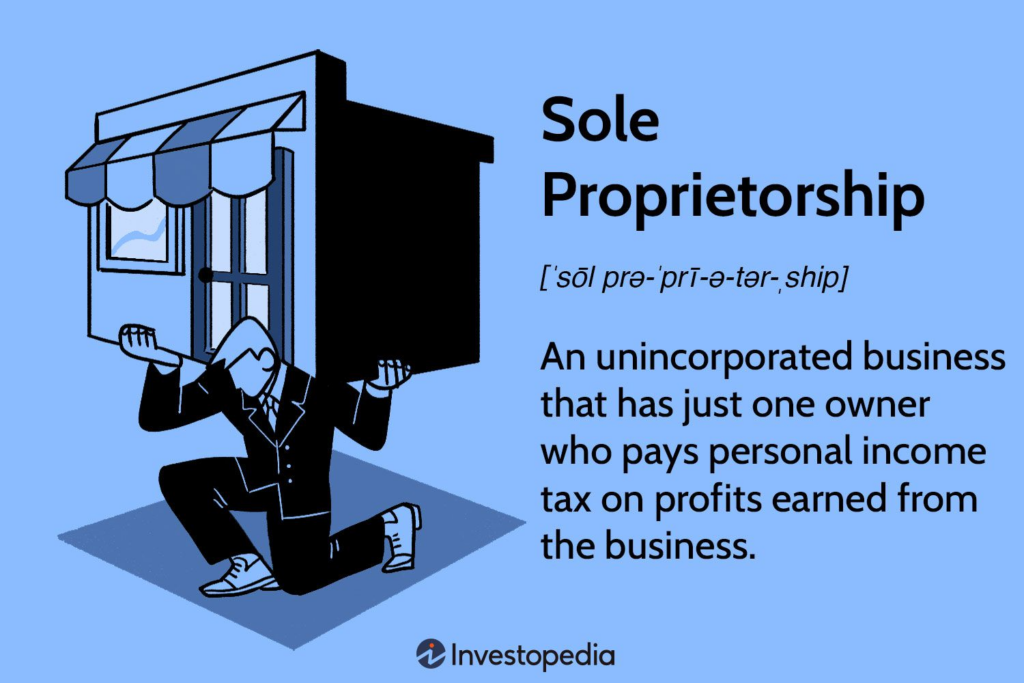
- Sole Proprietorship is the default structure for self-employed individuals. You and the business are legally the same entity, which means all business income flows directly to your personal tax return and all business liabilities are personally yours.
- LLC (Limited Liability Company) creates a legal separation between you and the business, shielding your personal assets from business debts and lawsuits. It's more flexible and has fewer formalities than a corporation, but by default, it's taxed similarly to a sole proprietorship.
- S Corporation is not technically a business structure on its own, it's a tax election made with the IRS. To elect S corp status, you first need to form an LLC or corporation. Once elected, the S corp allows business income to pass through to shareholders' personal tax returns, while also creating an opportunity to reduce self-employment taxes by splitting income between a salary and shareholder distributions.
- C Corporation is a fully separate legal and tax entity. It pays corporate-level taxes and shareholders pay taxes again on dividends, often referred to as "double taxation." This structure is more suited for larger companies or those seeking venture capital.
For most sole proprietors ready to level up, the comparison comes down to an LLC versus an S corporation, and understanding that distinction is key to making the right call for your business.
Sole Proprietorship vs. S Corp: Key Differences
The most significant difference between a sole proprietorship and an S corp is how self-employment taxes are handled.
As a sole proprietor, all net profits are subject to self-employment tax, currently 15.3%, which covers Social Security and Medicare. This applies to every dollar of profit, regardless of how much you actually take home.
With an S corp, you split your income into two categories: a reasonable salary (subject to payroll taxes) and shareholder distributions (not subject to self-employment taxes). This means only your salary portion faces that 15.3% hit, while distributions are taxed only at your individual income tax rate. For high-earning business owners, this can translate into tens of thousands of dollars in annual tax savings.
Beyond taxes, the S corp also provides limited liability protection. Your personal assets, your home, savings, personal bank accounts, are shielded from business creditors and legal claims in a way they never would be under a sole proprietorship.
That said, the S corp comes with more administrative responsibilities. You'll need to run payroll, maintain corporate formalities like meeting minutes and officer roles, file a separate corporate tax return (Form 1120-S), and pay yourself a salary that the IRS considers "reasonable." This is where having the right HR and payroll tools, like those offered by Paismo, makes a real difference in keeping operations smooth without adding unnecessary overhead.
Sole Proprietorship vs. Partnership
If you're running your business alone, a sole proprietorship is the default. But the moment a second person joins the equation, you're looking at a partnership, and the distinction matters more than most people realize.
A general partnership is formed automatically when two or more people go into business together, much like how a sole proprietorship requires no formal registration. Both partners share in the profits, debts, and liabilities of the business equally, unless a partnership agreement says otherwise. That shared liability is the biggest red flag. Just like a sole proprietor, general partners are personally responsible for business debts, but it goes a step further: you can be held liable for your partner's business decisions and mistakes, even ones you had no part in.
A limited partnership offers a middle ground, allowing for "silent" investors who contribute capital but aren't involved in day-to-day decisions, limiting their personal liability to the amount they've invested. The general partner, however, still carries full personal liability.
Neither structure offers the legal protection of an LLC or the tax advantages of an S corp election. For most growing businesses, whether solo or co-founded, a partnership is rarely the destination. It's often a stepping stone that works well in the early stages, but quickly exposes its limitations as revenue, headcount, and risk all grow. That's when restructuring into a more formal entity becomes not just smart, but necessary.
When Should You Switch?
Timing matters. Converting too early means taking on administrative costs that may outweigh your savings. Converting too late means leaving money on the table.
Here are the clearest signals that it's time to seriously consider the switch:
Your profits have crossed a meaningful threshold. Most tax professionals cite $40,000 to $60,000 in annual profit as the range where S corp savings start to exceed the added costs. Below that, the bookkeeping, payroll administration, and filing fees may cancel out any tax benefits. Above it, the math starts working in your favor, and the higher your profits, the more you stand to save.
You're paying significant self-employment taxes. If you're writing a large check to the IRS each year and watching it go almost entirely toward self-employment taxes, an S corp election allows you to restructure how that income is classified.
You want to protect your personal assets. If your business is growing, taking on contracts, employing people, or operating in a space with legal risk, remaining a sole proprietor leaves your personal finances exposed. An S corp changes that.
You're planning to hire employees or scale operations. Once you start building a team, you'll need proper payroll infrastructure anyway. Setting up an S corp at this stage means the administrative groundwork supports both the entity structure and the team you're building.
You want to improve business credibility. Clients, vendors, and partners often view incorporated entities more favorably. Having "Inc." or "LLC" attached to your name signals stability and professionalism that a sole proprietorship simply can't convey.
You're thinking about benefits. S corp shareholders who are also employees may be eligible for tax-advantaged benefits like retirement plan contributions and health insurance deductions, which can be more favorable than what's available to sole proprietors.
How to Convert a Sole Proprietorship to an S Corp: Step by Step
Once you've decided to make the move, the process itself is more straightforward than most people expect. Here's how to do it.
Step 1: Form an LLC or Corporation
Since an S corp is a tax designation rather than a legal structure, you need a formal legal entity first. For most small business owners, that means registering as a Limited Liability Company in your state.
The process typically involves filing Articles of Organization (sometimes called a Certificate of Formation or Certificate of Organization) with your state's Secretary of State office. You'll also need to draft an Operating Agreement, a document that outlines how the business is run, who the members are, and how decisions are made. If you're a solo operator, this is a straightforward document that primarily covers you.
Filing fees vary by state, and processing times can range from a few days to several weeks depending on where you're located. Some states offer expedited processing for an additional fee.
Step 2: Obtain an Employer Identification Number (EIN)
An EIN is the business equivalent of a Social Security number, it's how the IRS identifies your company for tax purposes. Even if you had an EIN as a sole proprietor, your new LLC or corporation is a separate legal entity and requires its own EIN.
You can apply for an EIN directly through the IRS website, and the process is free and typically completed in minutes.
Step 3: Open a Dedicated Business Bank Account
One of the important steps people overlook is separating personal and business finances at the banking level. Once your LLC is formed and you have an EIN, open a business bank account in the company's name. All revenue and expenses should run through this account going forward.
This separation isn't just good financial hygiene, it's also essential for maintaining the liability protection the LLC structure provides. Commingling personal and business funds can expose you to "piercing the corporate veil," which could eliminate your liability shield in the event of a lawsuit.
Step 4: Verify S Corp Eligibility
Not every business automatically qualifies for S corp status. Before filing, confirm that your company meets the IRS's requirements. The business must be a domestic corporation, have no more than 100 shareholders, have only one class of stock, and all shareholders must be U.S. citizens or residents. Certain types of businesses, such as some financial institutions and insurance companies, are ineligible.
For the vast majority of small business owners converting from a sole proprietorship, these requirements won't pose any issues.
Step 5: File IRS Form 2553
This is the critical step that officially elects S corporation tax status. Form 2553, formally titled "Election by a Small Business Corporation," must be submitted to the IRS with signatures from all shareholders.
Timing matters here. If you want your S corp election to take effect for the current tax year, you must file Form 2553 within 75 days of forming your entity, or by March 15th of the tax year in which you want the election to apply. Missing this window means your election won't take effect until the following tax year.
The form itself asks for basic business information: your company name, EIN, address, date of incorporation, the date you want the election to take effect, and shareholder details. For most sole proprietors making the conversion, that shareholder section will simply be your own information.
There is no filing fee for Form 2553.
Step 6: Register for State Taxes (If Required)
Some states have their own S corp recognition process, separate from the federal filing. Certain states automatically honor the federal election, while others require a separate state-level filing or may not even recognize S corp status at all. A handful of states also impose additional franchise taxes or fees on S corporations.
Check with your state's department of revenue or a local accountant to understand what additional steps apply in your jurisdiction.
Step 7: Set Up Payroll
This is arguably the most operationally significant step, and it's where many new S corp owners stumble. Once you've elected S corp status, you are required to pay yourself a "reasonable salary" as an employee of your own company. This salary is subject to payroll taxes and must be reported on a W-2.
The IRS pays close attention to S corp owners who take little or no salary and classify all of their income as distributions, this is a known tax avoidance strategy that can trigger audits and penalties. The definition of "reasonable salary" is generally what you would pay someone else to do your job in the open market.
Setting up payroll properly, with the right withholding, tax deposits, and compliance filings, requires either a solid understanding of payroll regulations or a reliable payroll solution. This is exactly where Paismo can help, automating your payroll runs.
Managing Your S Corp Day-to-Day
Once your S corp is up and running, a few things will feel noticeably different from operating as a sole proprietor.
Owner payments now come in two forms: a W-2 salary and shareholder distributions. These are not interchangeable. Salary comes through payroll and is subject to payroll taxes. Distributions are separate and come out of remaining profits after salary has been paid. Getting this classification right is critical.
You'll also take on ongoing administrative responsibilities that didn't exist as a sole proprietor. Annual filings, payroll processing, corporate record-keeping, and potentially a more complex tax return (Form 1120-S) are all part of the package. These costs are real, but for most businesses earning above the profit threshold, the tax savings more than compensate.
Bookkeeping also becomes more important. You'll want clean, separate records for all business income and expenses, not just for tax purposes, but to protect your liability shield. Paismo's HR and payroll tools integrate seamlessly into this framework, ensuring your employee records, payroll history, and compliance documentation are always up to date and audit-ready.
Common Mistakes to Avoid
- Not paying yourself a reasonable salary. The IRS scrutinizes S corps closely for this. If your salary is unreasonably low relative to your distributions, you could face back taxes, penalties, and interest.
- Converting before you're ready. If your profits don't yet justify the added costs, you may end up spending more on accounting and administration than you save on taxes. Model out the numbers before committing.
- Missing the Form 2553 deadline. Filing late pushes your election to the following tax year, costing you potential savings for an entire year.
- Commingling personal and business finances. This puts your liability protection at risk and makes tax filing significantly more complicated.
- Ignoring state-level requirements. Federal S corp status and state recognition are not always automatic. Check your state's specific rules before assuming you're fully covered.
Is an S Corp Right for Every Sole Proprietor?
Not necessarily. An S corp offers real advantages for many growing businesses, but it isn't the right fit for everyone.
If your business model requires more than 100 shareholders or the ability to issue multiple classes of stock, you'll eventually outgrow the S corp structure. If your profits are still below the break-even threshold for the added administrative costs, the timing may not be right yet. And if you're operating in a state that doesn't recognize S corp status or imposes heavy franchise taxes, the math may not work in your favor.
The best approach is to sit down with a qualified accountant or tax advisor, model your specific numbers, and make the decision based on your actual situation, not general advice.
Final Thoughts
Converting a sole proprietorship to an S corp is one of the most powerful structural decisions a growing small business owner can make. It protects your personal assets, creates a tax strategy that works in your favor, and sets the foundation for a more scalable, professionally structured business.
The process, while involving several steps, is well within reach for most business owners, especially with the right tools supporting your payroll, HR, and compliance needs. Paismo is built to make the operational side of running a structured business as effortless as possible, so you can focus on growth rather than paperwork.
This blog is intended for informational purposes only and does not constitute legal, tax, financial, or HR advice. Please consult a qualified professional before making structural or tax decisions for your business.
Become a part of the Paismo community
Paismo is an HR software that can help simplify your HR operations. In today's dynamic economic environment, efficient HR and automated payroll management are no longer a luxury but a necessity. Paismo is a comprehensive solution that transforms traditional HR complexes into streamlined and automated workflows. Paismo and its paired biometric device integration can be used for your business to mark employee attendance and record their timesheets accurately.
Paismo simplifies your tasks with its core HRMS, timesheets, and attendance management, as well as biometric attendance, payroll automation, and leave management system.

Take the first step toward modernizing your HR and payroll processes and explore what Paismo can do for you. Book a demo with our sales team.