


Highlights
- A job leveling matrix clarifies roles, responsibilities, and career growth for all employees.
- It organizes positions by job levels, job families, and skills needed for advancement.
- The matrix helps align compensation, skills, and impact with each role.
- Templates simplify the creation and implementation of a transparent, structured career framework.
- Real-world examples show how companies tailor matrices to drive growth and enhance performance.
Creating a clear role structure is essential for fair growth and consistency. However, many organizations struggle to define job levels simply. That’s where a job leveling matrix helps by outlining responsibilities, skills, and career paths. In this guide, you’ll learn how to create a job leveling matrix using practical templates and real examples. Moreover, when supported by tools like HRMS or HR software, the process becomes easier to manage and scale. In this article, you will learn who uses job leveling, its key components, the simple creation steps, how to apply a template, and real-world examples.
Who Uses a Job Leveling Matrix?

A job leveling matrix helps HR teams, managers, and leaders define roles clearly, set responsibilities, and guide career growth. In other words, it links job titles with the skills, experience, and tasks required at each level of employment. As a result, employees understand how they can advance in their careers and what is expected of them.
Every organization, big or small, can benefit from a job leveling matrix. For example, small businesses may use a simple version to show basic career paths. On the other hand, larger companies often use detailed frameworks to manage many roles and teams. Overall, job leveling matrices improve transparency, support employee growth, and help retain top talent.
Key Components of a Job Leveling Matrix
A job leveling matrix relies on several essential components that define roles, responsibilities, and career growth paths. First, it helps organizations set clear expectations for every position.
Job Levels
Job levels indicate the ranks and responsibilities within your organization, ranging from entry-level contributors to senior leadership. Common groupings include:
- Junior
- Mid-level
- Senior
- Leadership
For more detail, sublevels such as Mid-level I, II, and III can be added to capture nuanced responsibilities.

Job Families
Job families group similar roles that share functions. For example, administrators in different departments may belong to the same family even if their day-to-day tasks differ.
Role Level Guidelines
A transparent matrix uses clear standards to justify role placement. These typically include:
- Scope of responsibility
- Decision-making authority
- Skills required for the role
- Impact on the organization
- Opportunities for lateral career moves
Overall, these components create clarity, support, and enhance leadership, helping employees understand how they can grow within the organization.
How to Build a Job Leveling Matrix in 9 Simple Steps?
A job leveling matrix helps organizations define roles, responsibilities, and career paths within their organization. By following these steps, you can create a framework that supports employee growth and drives business success. Tools like Paismo’s performance suite make managing the matrix easy.
Step 1: Define the Scope and Framework
Start by clarifying why your company needs a job leveling matrix.
- Identify goals such as reducing turnover, leveling compensation, or clarifying role boundaries.
- Determine the number of levels and job families based on the company's size and structure.
- Assign responsibility and gather input from stakeholders.
Step 2: Analyze Your Current Workforce
Understand the current structure to see where roles and skills align.
- Create an inventory of positions and responsibilities.
- Map reporting lines and relationships between roles.
- Identify core and role-specific skills needed for success.
Step 3: Define Job Families and Roles
Group similar roles to provide clarity and accountability.
- Organize roles by function, occupation, business unit, or skill.
- Define the responsibilities and expected outcomes for each role.
- Keep roles distinct but related, such as grouping sales and marketing teams.
Step 4: Clarify Each Level
Explain how employees can progress in their careers.
- Define the scope of responsibility at each management level.
- Outline required skills, competencies, and organizational impact.
- Set promotion requirements so employees understand growth expectations.
Step 5: Develop the Matrix Structure
Make the matrix visual and easy to understand.
- Place job roles on the x-axis and levels on the y-axis.
- Include responsibilities, skills, and impact at each intersection.
- Ensure managers and employees can clearly see career progression.
Step 6: Align Compensation With Job Levels
Pay should match responsibility, skills, and impact.
- Conduct market research to benchmark salaries.
- Define structured pay ranges and in-level progression.
- Include bonuses and incentives for each level.
Step 7: Validate and Communicate the Matrix
Get feedback to ensure accuracy and clarity.
- Share the matrix with HR leaders and managers.
- Refine it for inclusivity and correctness.
- Communicate it to employees through workshops, guides, and Q&A sessions.
Step 8: Educate Leadership and HR Teams
Managers must understand the framework to guide employees effectively.
- Train leaders on promotion requirements and level distinctions.
- Integrate the matrix into performance evaluations and development conversations.
- Use Paismo to track progress and support career discussions.
Step 9: Roll Out the Job Leveling Framework
Implement the matrix with clear guidance and support.
- Decide on phased or full rollout and designate points of contact.
- Integrate with existing HR systems and collect feedback on a regular basis.
- Update the matrix as roles and business needs evolve.
Job Leveling Matrix Template
You don’t need to start from scratch when creating a job leveling matrix. Using a template helps you clearly organize roles, responsibilities, and career progression. It also facilitates implementation and ensures consistency throughout your organization. You can even integrate it with a performance review template to track employee progress and development at each performance level.
Here’s a simple, sequential template to get started:
| Job Role | Level 1 (Entry) | Level 2 (Intermediate) | Level 3 (Senior) | Level 4 (Leadership) |
| Junior Accountant | Assist with basic tasks | Prepare financial reports | Review reports | N/A |
| Staff Accountant | Support financial reporting | Analyze transactions | Lead the month-end close | N/A |
| Senior Accountant | Mentor junior staff | Lead reporting processes | Oversee financial operations | N/A |
| Accounting Manager | Manage daily operations | Train and guide staff | Lead financial strategy | Guide organizational decisions |
How to Use This Template:
- Identify Career Paths: Map roles across levels to provide employees with a clear progression.
- Define Competencies: Include required skills and abilities for each level to guide growth.
- Outline Responsibilities: Specify tasks and expectations at every level for clarity.
This template ensures transparency in career growth, enabling managers to make fair decisions on promotions and responsibilities while maintaining employee development as measurable and structured as possible.
Job Leveling Matrix Example
Learn from how top companies design and implement their job leveling matrices. These examples show different approaches to structuring roles, responsibilities, and career progression.
Wise
Money transfer company Wise recently updated its leveling matrix to provide more clarity for employees. Each role now includes:
- Skills required to perform effectively
- Expected behaviors and expertise
- Scope of responsibility and impact on teamwork and company culture
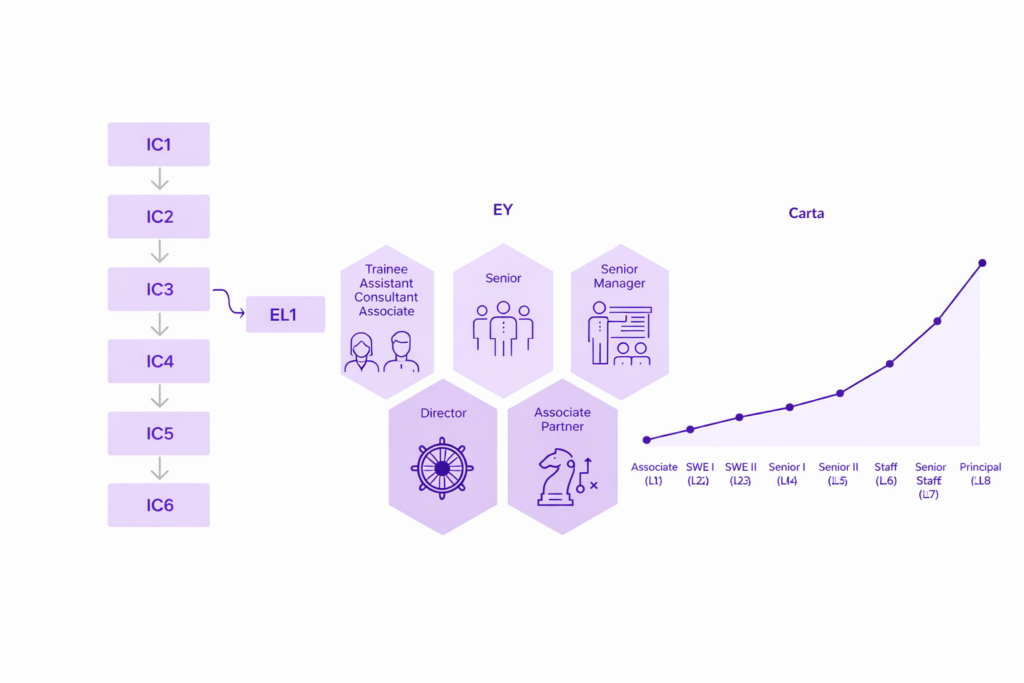
EY
EY focuses on career development opportunities with a seven-level framework:
- Entry-level employees: Trainees, associates, and consultants
- Seniors: Employees with initial management responsibilities
- Managers: Oversee multiple projects and client communications
- Senior Managers: Lead expanded client relationships and sales initiatives
- Directors: Manage complex projects and larger teams
- Associate Partners: Directors responsible for top-level strategies
- Partners: Co-owners with entrepreneurial focus
Carta
Carta uses an eight-level framework, with some levels being more challenging to achieve than others:
- Employees must demonstrate consistent performance over time to advance
- Management roles are treated as lateral moves, with levels M4 to M9 instead of L1 to L8
- Compensation increases with seniority, with equity growing faster at higher levels, making it a key factor in the leveling structure
These examples illustrate how companies tailor job leveling matrices to reflect their distinct organizational structures, career paths, and performance expectations.
Summary
A job leveling matrix clarifies roles, responsibilities, and career paths, helping employees understand how to advance in their careers. It organizes positions by levels, job families, and required skills while aligning compensation. Using templates makes creation easier and ensures consistency. Following steps from defining roles to rolling out the matrix support transparency, fair promotions, and employee development. Real examples show how top companies apply it.
Become a part of the Paismo community
Paismo is an HR software that can help simplify your HR operations. In today's dynamic economic environment, efficient HR and automated payroll management are no longer a luxury but a necessity. Paismo is a comprehensive solution that transforms traditional HR complexes into streamlined and automated workflows. Paismo and its paired biometric device integration can be used for your business to mark employee attendance and record their timesheets accurately.
Paismo simplifies your tasks with its core HRMS, timesheets, and attendance management, as well as biometric attendance, payroll automation, and leave management system.
Take the first step toward modernizing your HR and payroll processes and explore what Paismo can do for you. Book a demo with our sales team.