


Key highlights
- Candidate pipeline management turns hiring from reactive to proactive by keeping a ready pool of qualified, engaged candidates at all times.
- A structured pipeline reduces time-to-hire and errors by centralising tracking, documentation, and handovers across teams.
- Maintaining candidate relationships over time improves quality of hire, leading to better role fit and lower early turnover.
- Strong pipelines enhance candidate experience and reduce costs by minimising last-minute scrambles, manual work, and agency dependency.
Open roles keep stacking up, great candidates disappear mid-process, and suddenly your hiring funnel feels more like a leak than a system. Candidate pipeline management defines how organisations source, track, engage, and move candidates from first interaction to onboarding. It directly impacts hiring speed, candidate experience, and long-term workforce planning.

So how can HR teams reduce time-to-hire and build a consistent flow of qualified talent instead of constantly starting from scratch? This guide breaks down practical steps around sourcing, applicant tracking, candidate nurturing, pipeline analytics, and the tools that support effective candidate pipeline management.
With Paismo’s all-in-one HR platform, teams can manage recruitment, candidate engagement, and onboarding workflows in one place, making it easier to oversee the entire hiring journey without unnecessary complexity.
What Is Candidate Pipeline Management?
Candidate pipeline management is the end-to-end practice of building and maintaining a ready pool of qualified, engaged candidates and converting them into successful hires when roles open.
In practice, this means you:
- Track potential candidates
- Nurture long-term relationships
- Validate skills and documentation
- Transition candidates smoothly into onboarding and payroll
Rather than reacting to vacancies, pipeline management allows teams to stay ahead of hiring needs.
Why Does Candidate Pipeline Management Matter?
Many teams treat candidate pipelines as purely a recruitment function. In reality, the moment an offer is made, the process extends into operations, compliance, and payroll.
Without a structured pipeline, common problems emerge:
- Candidates go cold due to slow follow-ups
- Compliance steps are handled inconsistently
- Payroll issues arise from fragmented data
When pipelines aren’t managed properly, recruiters spend more time fixing process gaps than engaging talent. Instead of being proactive, hiring becomes a constant cycle of firefighting.
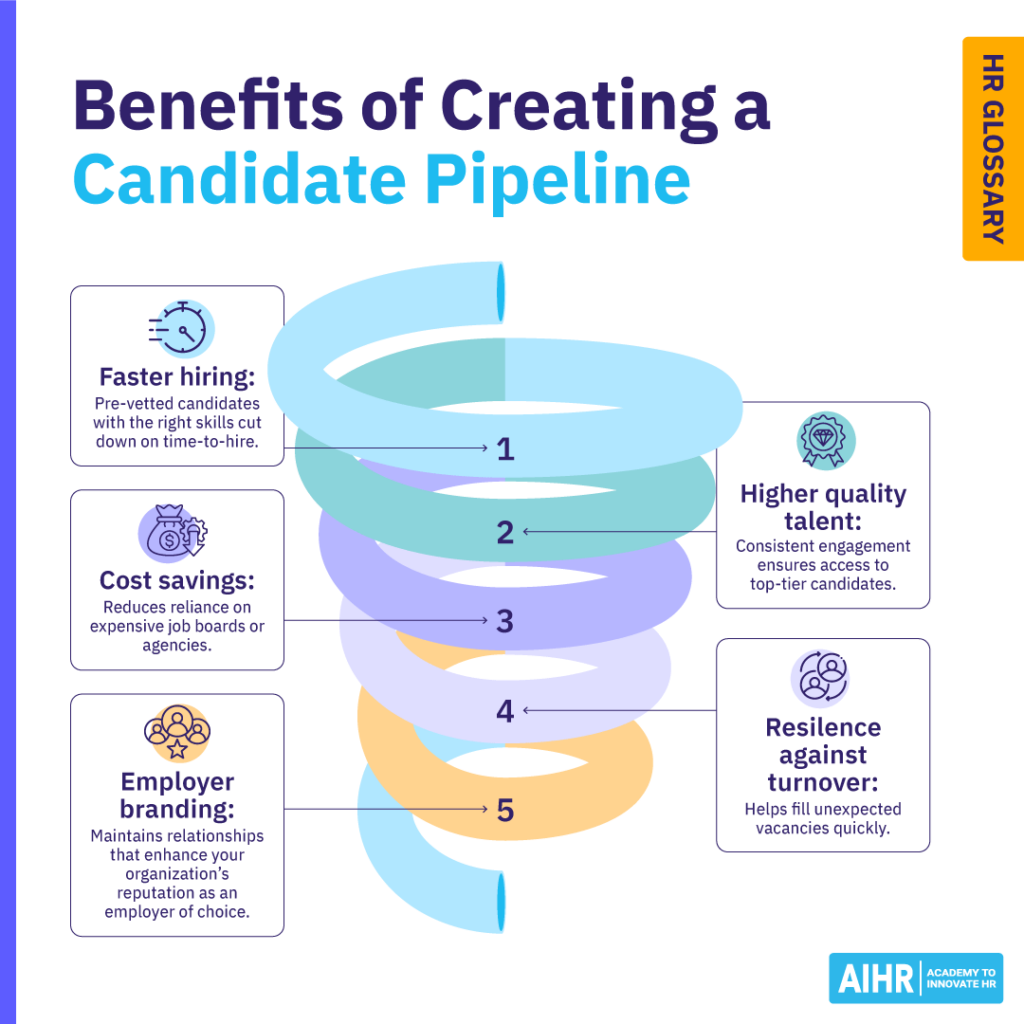
How Candidate Pipeline Management Breaks Down in Real Life
This challenge is especially visible in fast-growing teams. As hiring volumes increase, spreadsheets, email threads, and disconnected tools start to fragment the process.
The result:
- Candidates fall between handovers
- Approvals take longer than expected
- Recruiters waste hours reconciling records
Outreach turns into triage. Engagement drops. Strong candidates accept other offers simply because your process couldn’t keep up.
The Hidden Cost of “Familiar” Hiring Processes
Most teams rely on manual trackers and informal approvals because they feel simple at first. But as hiring scales, more stakeholders, regulations, and payroll requirements enter the picture.
What once felt manageable now creates:
- Data inconsistencies
- Compliance risks
- Delays between offer and start date
This is where structured candidate pipeline management systems make a real difference. A single source of truth allows teams to move from candidate to employee faster, with fewer errors and better visibility across the entire process.
Measuring the Impact on Time-to-Hire
One of the biggest benefits of candidate pipeline management is speed. When candidates are already tracked, pre-qualified, and engaged, teams avoid restarting the hiring cycle for every role.
A well-managed pipeline can reduce time-to-hire by up to 30%, helping organisations maintain momentum instead of losing productivity to prolonged vacancies.
What Should You Measure in Your Pipeline?
To understand whether your candidate pipeline is working, focus on:
- Conversion rates at each stage
- Time spent in each stage
- Documentation readiness at offer stage
- Post-hire payroll or data corrections
These metrics reveal:
- Where candidates drop off
- Where compliance becomes fragile
- Where manual work slows everything down
Think of your pipeline like a conveyor belt. When it’s aligned, candidates move steadily with quality checks built in. When it’s misaligned, everything jams.
Benefits of Maintaining a Strong Candidate Pipeline
Effective candidate pipeline management transforms hiring from a reactive scramble into a predictable, repeatable system.
Key benefits include:
- Faster hiring cycles
- Higher-quality candidates
- Clearer handoffs between teams
- Reduced dependency on agencies
- Better candidate experience
Instead of treating every hire as an emergency, teams operate with confidence and control.
How Does a Candidate Pipeline Speed Things Up?
Pre-qualified candidates eliminate the need to repeat basic checks during urgent hiring. Approvals, documentation, and onboarding are already prepared.
This removes bottlenecks at the most critical stage, between offer and start date, so roles get filled faster without sacrificing accuracy or compliance.
How Does It Improve Quality of Hire?
A maintained pipeline allows hiring managers to assess candidates over time, not under pressure. Instead of making decisions based on one interview, teams observe engagement, communication, and skill progression across multiple touchpoints.
This leads to:
- Better cultural fit
- Stronger role alignment
- Lower early turnover
Quality of hire improves because decisions are based on patterns, not urgency.
Impact on Cost, Fairness, and Candidate Experience
When hiring is rushed, recruiters burn time fixing data issues and candidates feel neglected. This drives up agency costs and offer decline rates.
With a structured candidate pipeline:
- Recruiters work more strategically
- Underrepresented talent pools receive consistent outreach
- Candidates experience clearer communication
- Offer acceptance rates increase
The process becomes more inclusive, more transparent, and more cost-effective.
The Real Cost of Manual Handoffs
Email threads and spreadsheets feel harmless, but as teams grow, they create:
- Approval delays
- Audit gaps
- Payroll corrections
- Data inconsistencies
Modern candidate pipeline management replaces fragmented handovers with centralised records, automated workflows, and consistent compliance logic. The result is a hiring process that scales smoothly instead of breaking under pressure.
Final Thoughts
At its core, candidate pipeline management is not just about recruiting faster, it’s about building a hiring system that works even when the business grows, roles multiply, and teams become more complex.
With the right structure and tools in place, your pipeline stops being a bottleneck and becomes one of your strongest operational advantages.
Become a part of the Paismo community
Paismo is an HR software that can help simplify your HR operations. In today's dynamic economic environment, efficient HR and automated payroll management are no longer a luxury but a necessity. Paismo is a comprehensive solution that transforms traditional HR complexes into streamlined and automated workflows. Paismo and its paired biometric device integration can be used for your business to mark employee attendance and record their timesheets accurately.
Paismo simplifies your tasks with its core HRMS, timesheets, and attendance management, as well as biometric attendance, payroll automation, and leave management system.
Take the first step toward modernizing your HR and payroll processes and explore what Paismo can do for you. Book a demo with our sales team.